What Is Kimi K3? China’s Massive New AI Model
Hello folks! There’s a new AI model out this week, and it’s not from OpenAI, Google, or Anthropic. It’s from a Chinese lab called Moonshot AI, and it’s rattling stock markets while quietly becoming one of the biggest, cheapest, and most powerful “open” AI models anyone has ever released. It’s called Kimi K3, and here’s what you actually need to know about it.
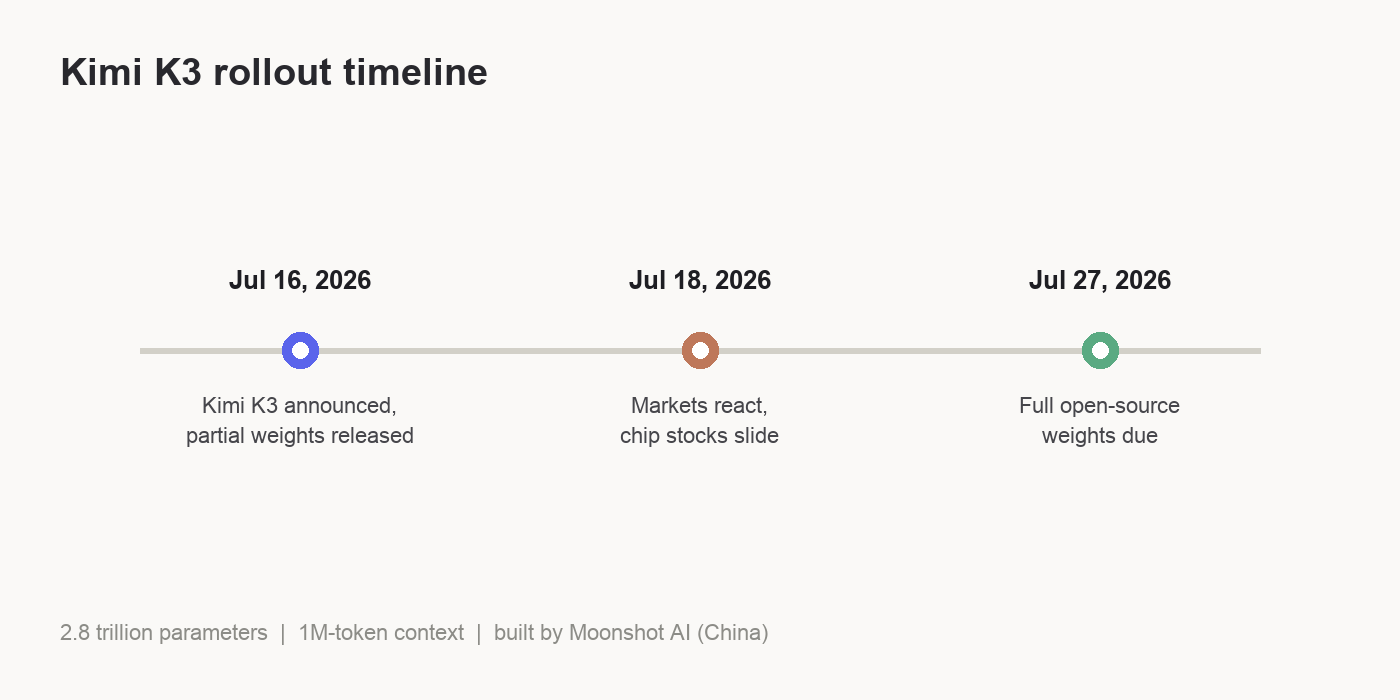
Quick answer: Kimi K3 is a new AI model from China’s Moonshot AI, released on July 16, 2026. At 2.8 trillion parameters, it’s the largest open-source AI model ever built, and independent tests put it roughly on par with Claude Opus 4.8 while costing significantly less to run. Full model weights arrive July 27. You can try it for free right now at kimi.com or through the Kimi app on iOS and Android.
What happened
On July 16, Moonshot AI released Kimi K3, a 2.8-trillion-parameter language model built for coding and everyday knowledge work. That size makes it roughly 75% bigger than DeepSeek’s V4 Pro, and Moonshot is calling it the largest open-source model in the world. Two days later, chip stocks took a hit on Wall Street as investors started asking an uncomfortable question: if a free, open model can compete with the best paid ones, what happens to the AI spending boom?
This isn’t the first time a Chinese lab has spooked markets with a surprise release. DeepSeek did something similar back in early 2025. Kimi K3 is the biggest jolt since then.
Key details: dates, specs, and price
- Release date: July 16, 2026, with full open-source weights scheduled for July 27.
- Size: 2.8 trillion parameters, using a mixture-of-experts design so it doesn’t run all of them at once.
- Context window: 1 million tokens, meaning it can hold huge documents or codebases in “memory” during a conversation.
- Benchmarks: On the independent Artificial Analysis Intelligence Index, Kimi K3 scored 57 versus 56 for Claude Opus 4.8 in its adaptive reasoning mode. That’s close enough to call it a genuine peer, not a knockoff.
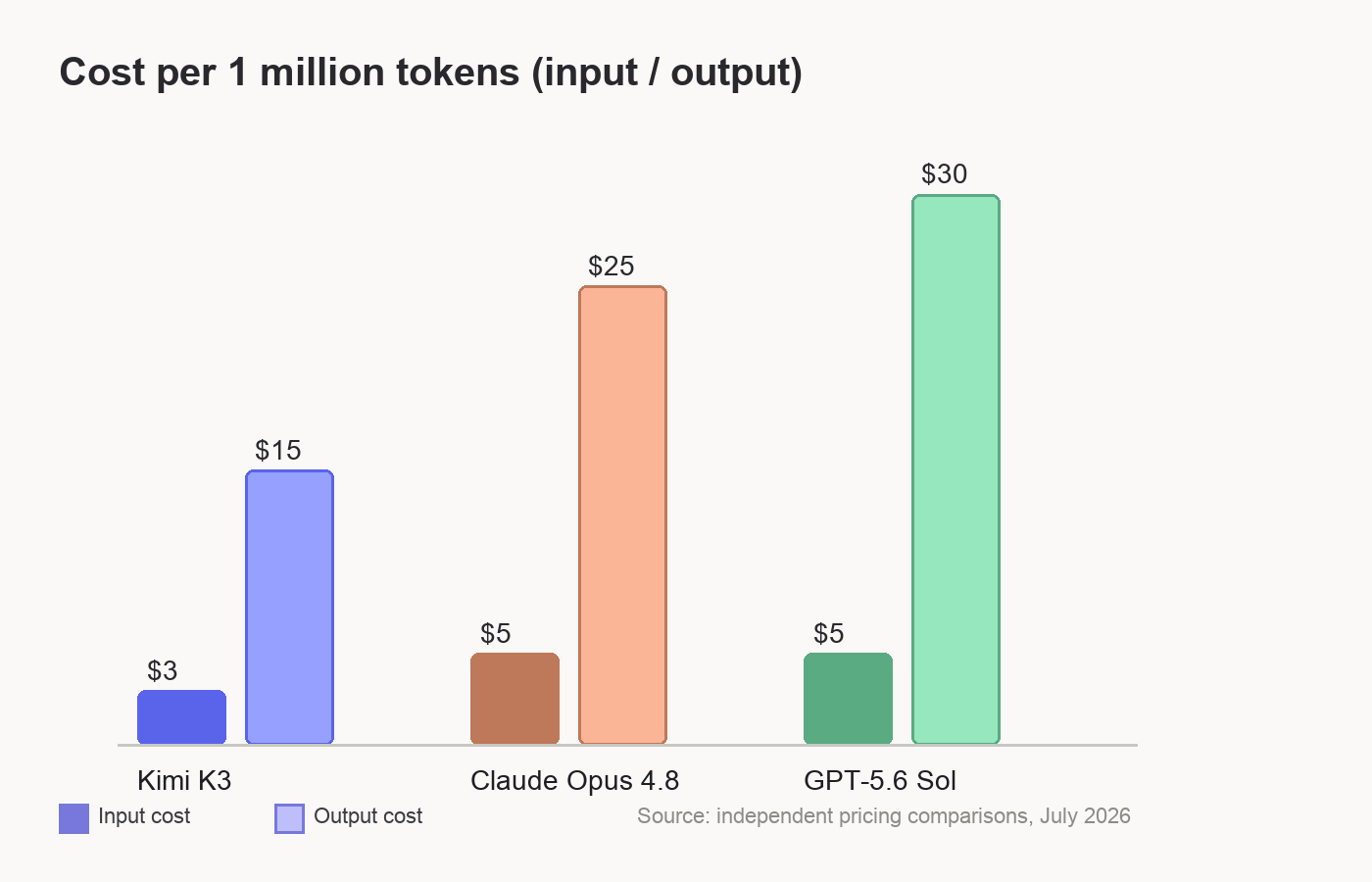
- Price: Through the API, Kimi K3 costs about $3 per million input tokens and $15 per million output tokens. Claude Opus 4.8 runs $5 and $25. GPT-5.6 Sol runs $5 and $30. Kimi is meaningfully cheaper across the board.
Worth a grain of salt: Moonshot also published its own benchmark numbers, which look even better than the independent ones. Self-reported scores from any company, including this one, deserve a bit of skepticism until outside labs reproduce them.
Why it matters to regular users
You probably don’t care about parameter counts. Fair. Here’s the part that affects you: competition like this tends to push prices down everywhere, not just at Moonshot. When a free or nearly-free model gets this close to the paid frontier, the companies charging premium prices feel pressure to either drop their own prices or add features that justify the gap. That’s good news if you’re paying for any AI subscription right now.
There’s also a bigger picture worth noticing. A lot of the most capable AI tools have come from a small handful of U.S. companies. Kimi K3 is a reminder that’s changing fast, and it means more real choices for anyone building an app, running a business, or just picking a chatbot to use day to day.
How to try Kimi K3
You don’t need an invite or a waitlist. Head to kimi.com on the web, or download the Kimi app from the App Store or Google Play. Sign in, and you’re chatting with K3 on the free tier right away.
A few practical notes before you dive in:
- The free tier doesn’t publish a fixed daily limit, so watch the usage indicator in the app instead of trusting random numbers you see online.
- Long, complex sessions (big documents, long coding runs) burn through your free allowance faster, since serving that 1-million-token context isn’t cheap for Moonshot either.
- If you’re pasting anything sensitive, like client data or unpublished code, read the current terms first. Free consumer AI tiers often reserve the right to use your chats to improve the product.
What’s next
The full open-source weights are due July 27, which is when developers everywhere will be able to download, modify, and self-host the model without paying Moonshot a licensing fee. Expect a fresh round of comparisons and independent testing once that happens, since self-hosted results tend to differ from hosted API demos. Markets will likely keep watching too. If chip and AI-infrastructure stocks stay jumpy through the end of the month, this story isn’t over.
FAQ
Is Kimi K3 free to use?
Yes, there’s a free tier for general chat and coding through the Kimi app and website. Heavier, more advanced features sit behind paid usage.
Is Kimi K3 better than Claude Opus 4.8?
They’re close. On one independent benchmark, Kimi K3 edged ahead slightly, but Claude Opus 4.8 still leads on a few specific tests. Call it a genuine rival rather than a clear winner either way.
Is Kimi K3 safe to use with sensitive data?
Treat it like any other consumer AI chatbot: read the current privacy terms before pasting anything private, since free tiers often allow your chats to be used for training.
When will the full model be available?
Moonshot says the complete open-source weights will be released by July 27, 2026, letting anyone download and run the model independently.
A Chinese lab just showed up with a model that’s cheaper and nearly as capable as the best from Silicon Valley. Are you going to give Kimi K3 a try, or wait and see how it holds up once more people put it to the test?
Sources: VentureBeat, Kimi AI