Claude Opus 5.5: what's new, price and how to use it
Hello Folks,
We at Daily Techocracy are back with some juicy info for all you kind readers....lets get to it !!
Anthropic has a new top model, and it's cheaper than the one it replaces. Claude Opus 5.5 arrived on 22 September 2026 as the first model in the Claude 5.5 family. If you've been wondering what changed, how much it costs and whether you need to do anything to use it, this is the short version in plain words.
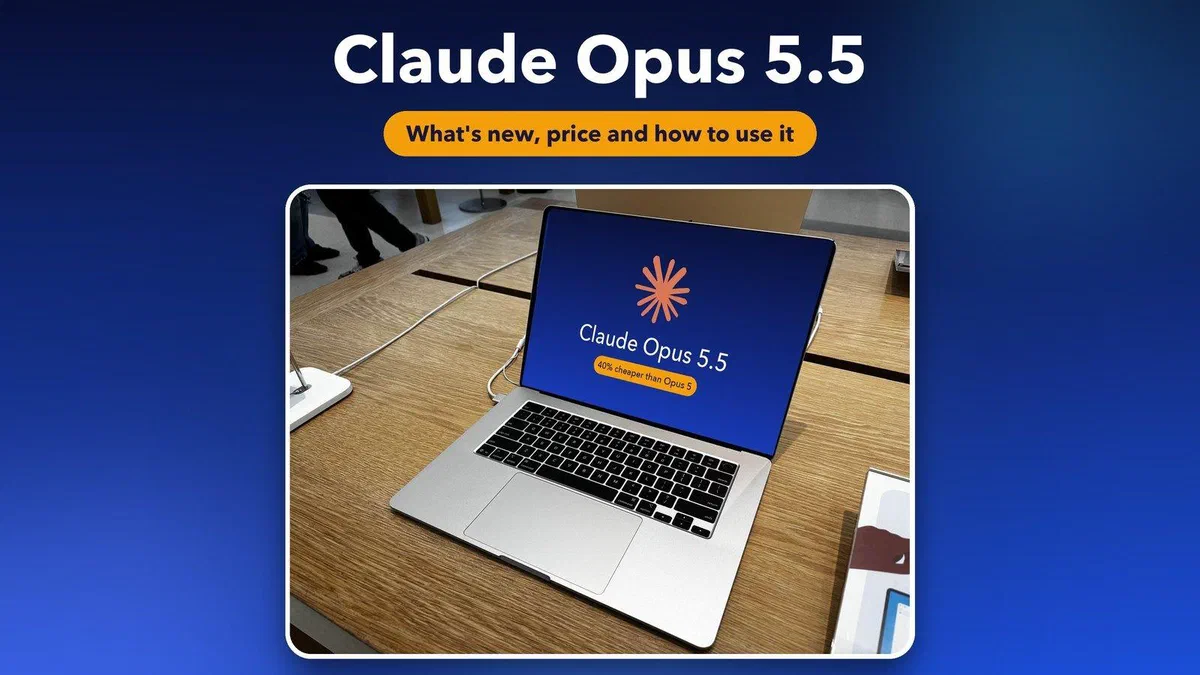
Quick answer: Claude Opus 5.5 is Anthropic's newest Opus model. Anthropic says it performs at about the level of Claude Fable 5.1 on most work and costs 40% less to run than Opus 5. API pricing is $4 per million input tokens and $20 per million output tokens. It's available in Claude and on Amazon Web Services, Google Cloud and Microsoft Azure.
What is Claude Opus 5.5?
Claude Opus 5.5 is a new AI model from Anthropic, and the first of the Claude 5.5 family. It's the successor to Claude Opus 5, and Anthropic's announcement says it leads the company's own benchmarks for agentic coding, computer use and knowledge work.
"Agentic" simply means the AI carries out a long job on its own, step by step, rather than answering one question. Anthropic also says the new model communicates more clearly than Opus 5, resists prompt injection (hidden instructions planted in a page or file) better and takes fewer actions that are hard to undo. Those are Anthropic's claims, so treat them as the company's view until more people have tested it.
How much does Claude Opus 5.5 cost?
The price is $4 per million input tokens and $20 per million output tokens. That's 40% less than Opus 5 on Anthropic's numbers, which charged $5 and $25. A token is a small chunk of text, roughly a short word or part of one.
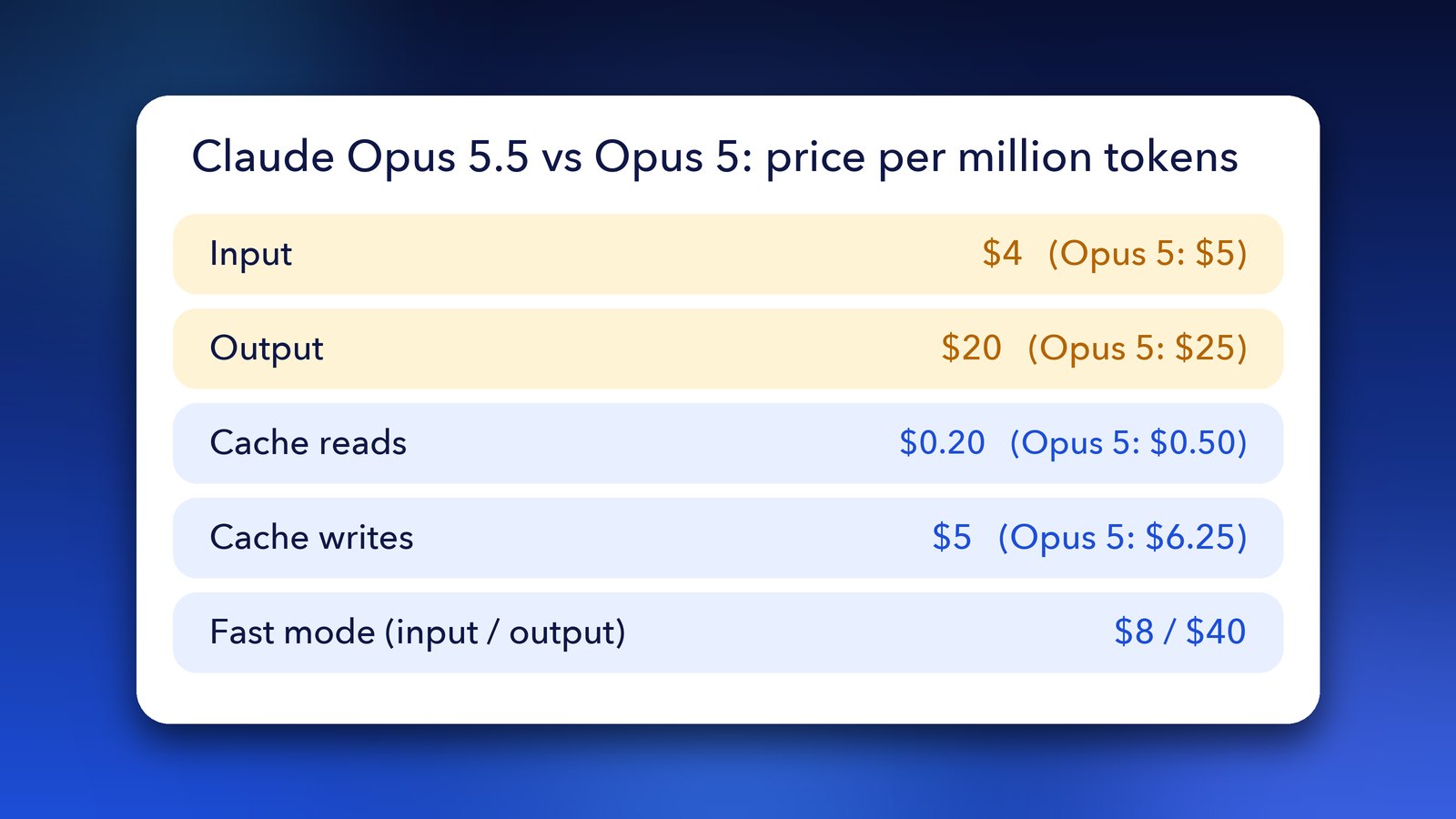
Anthropic lists cache reads at $0.20 and cache writes at $5 per million tokens, against $0.50 and $6.25 for Opus 5. Fast mode costs $8 for input and $40 for output. An outside report from The Batch puts batch processing at half the standard price, or $2 and $10.
One caution on cost. The same report found that Opus 5.5 uses more tokens per task than earlier Opus models, so the real bill for a job may not fall by a full 40%. Test it on your own work before you assume the saving.
How good is Claude Opus 5.5?
Independent tests rank it at the top right now. The Artificial Analysis Intelligence Index gave it a score of 58, which The Batch reports as first among the models tested. That's 7 points above Opus 5 and 5 points above both Claude Fable 5.1 and GPT-6 Astra.
Anthropic's own message is a little more modest. It says Opus 5.5 does about what Fable 5.1 does on most work, at a lower cost. Both can be true, since benchmarks and everyday jobs don't always line up. If you want to see how the competition looks, our posts on GPT-6 in ChatGPT and Gemini 4 Argon cover the rivals.
What are the effort levels in Claude Opus 5.5?
There are five effort levels: low, medium, high, xhigh and max. They control how hard the model thinks before it answers. Lower levels are faster and use fewer tokens, and higher ones spend more effort on tough problems.
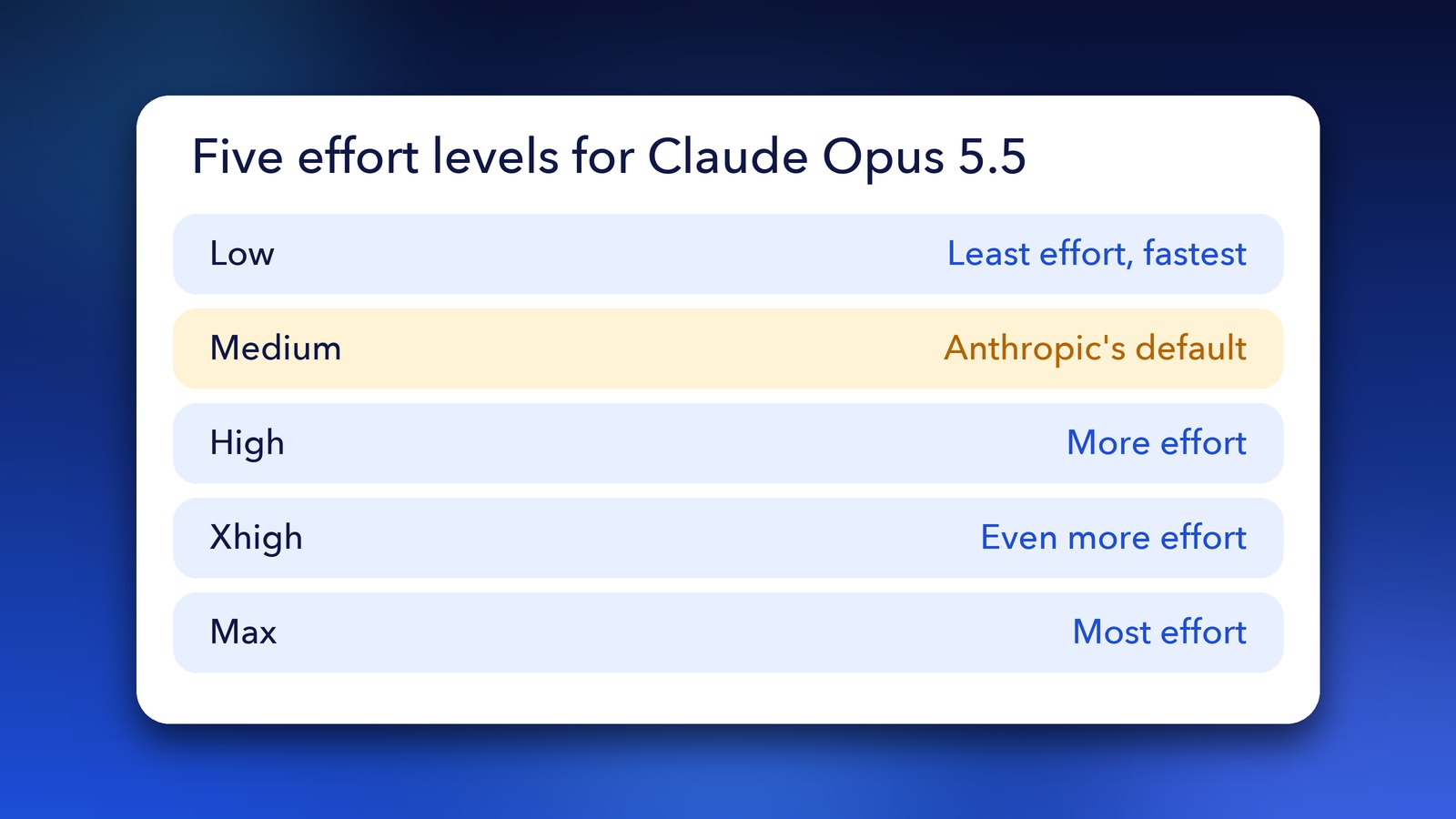
Anthropic's announcement names medium as the default, while The Batch says high, so check the setting in the tool you use. Anthropic also says thinking can't be switched off on this model. If you built something on an older Opus that ran without thinking, test it again before you move over, because replies may now be longer.
What is fast mode?
Fast mode makes Opus 5.5 answer up to 2.5 times faster for a higher price. Anthropic says it's available in Claude Code and on the Claude Platform, and it costs $8 per million input tokens and $40 per million output tokens. That's double the normal rate. It's worth it when you're waiting on the answer. It's a waste on jobs that can run in the background.
How much can Claude Opus 5.5 handle at once?
The Batch reports that it accepts text and images up to 1 million tokens, which is roughly the length of several long books. It can produce up to 128,000 tokens in a single reply, and up to 300,000 through the batch service. Its knowledge cutoff is June 2026, so it knows nothing newer unless you give it the information. Anthropic's announcement page doesn't state the context size, so these figures come from the outside report.
Where can you use Claude Opus 5.5?
You can use it in Claude, through the Claude Platform API, and on Amazon Web Services, Google Cloud and Microsoft Azure. Developers call it with the model name claude-opus-5-5. Zero data retention is available for companies that need it.
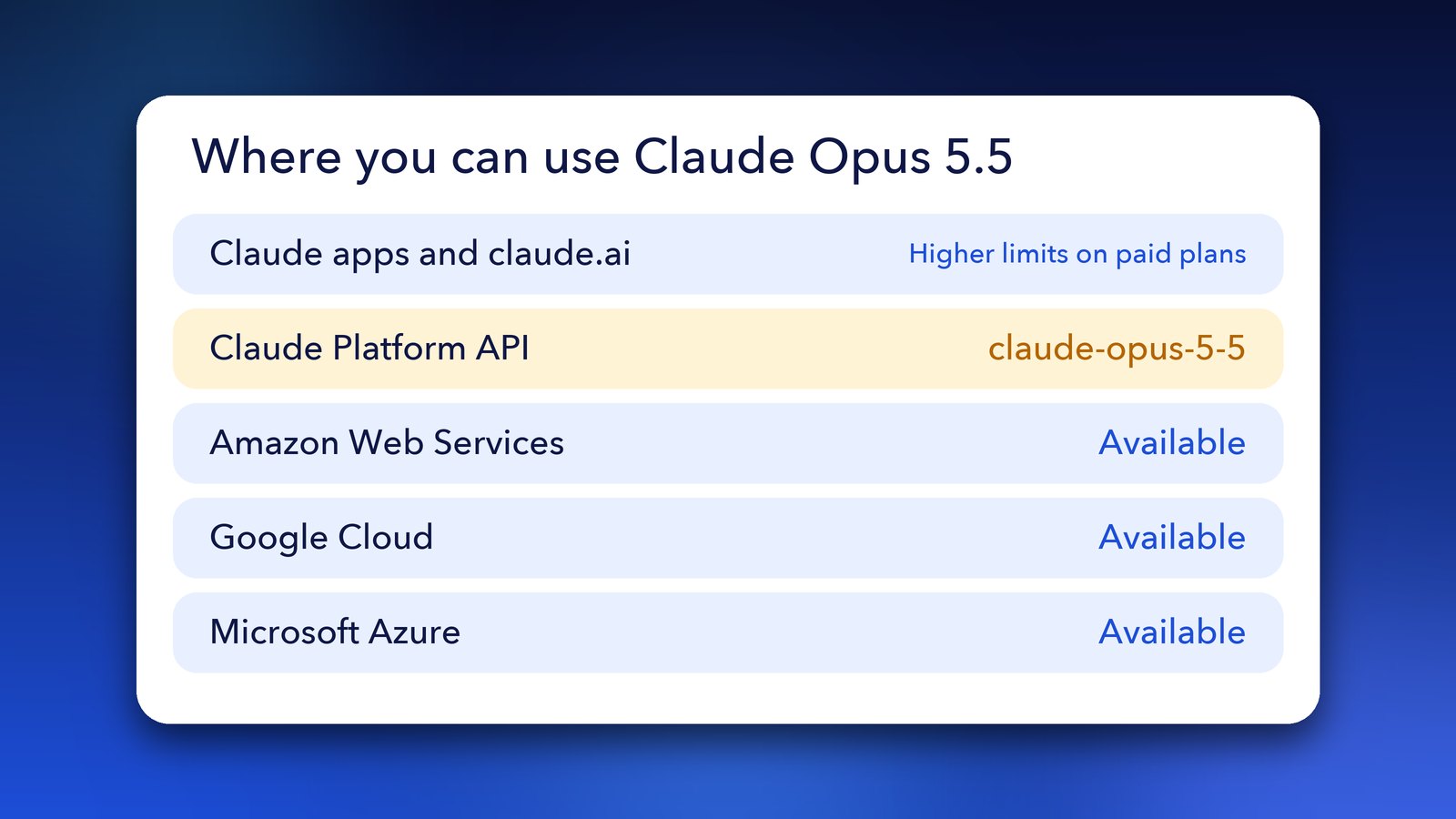
If you pay for Claude, Anthropic also raised the five-hour usage limits on Pro, Max, Team and seat-based Enterprise plans. Subscribers got a rate limit reset they can save and use later. Free users should check the model picker in the app to see what's on offer for their account, because the announcement doesn't say.
What are the catches with Claude Opus 5.5?
There are three to know about. The first is that it's a closed model, so Anthropic hasn't shared its weights or how it was built. The second is that for certain sensitive cybersecurity and biology questions, The Batch says it falls back to the older Claude Opus 4.8. Anthropic points qualified researchers to its Life Sciences and Cyber Verification Programs. The third is that it may refuse some legitimate safety or biomedical work, according to the same report.
Are Sonnet 5.5 and Haiku 5.5 coming?
Anthropic said at launch that Sonnet 5.5 and Haiku 5.5 would follow in the coming weeks. Those are the smaller, cheaper models in the family. If cost matters more to you than top scores, they're worth waiting for. Check Anthropic's news page for the latest, since I couldn't confirm their release dates here.
For most people the takeaway is simple. You get a stronger model at a lower price. Developers should test the effort levels and the token use before they switch over.
Image credits: laptop photo "MacBook Air (15-inch, M4, Silver)" by AzureSaturn on Wikimedia Commons (CC0). Claude symbol from Wikimedia Commons (CC0). The screen shown on the laptop is our own illustration.